Valley of Flowers
Description :

Altitude
14100 ft.

Duration
6 Days

Trek Length
37km

Base Camp
Pipalkoti

Trek Difficulty
Easy to Mod

Transportation
Included
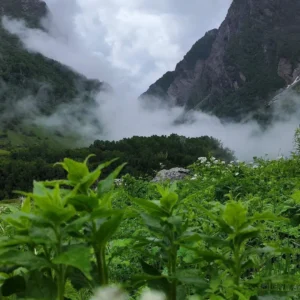
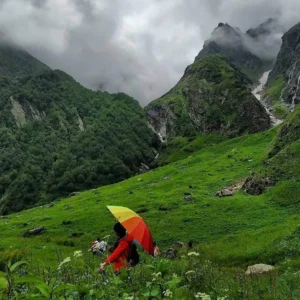
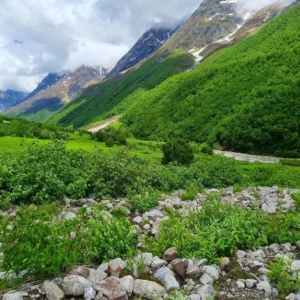
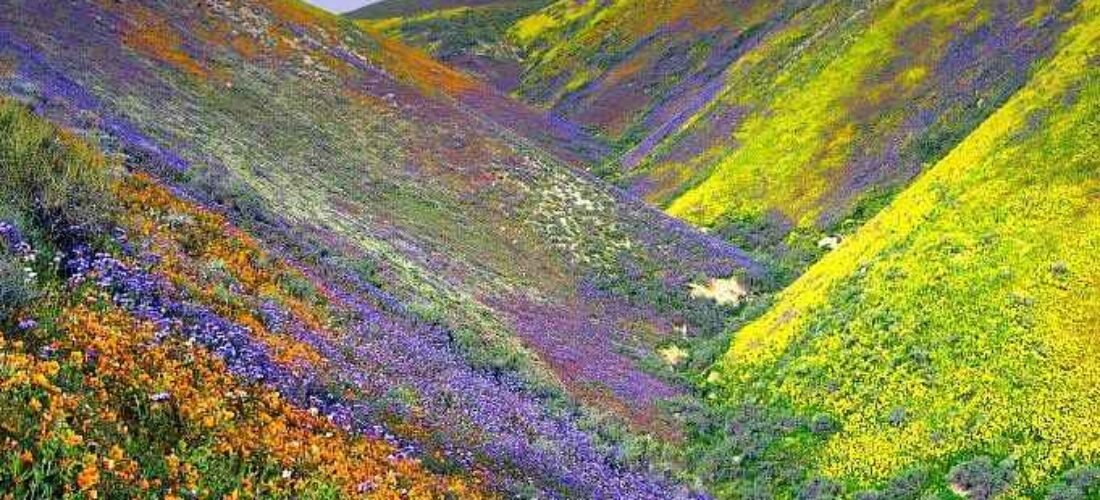
Valley of Flowers is an easy to moderate trek that offers rare access to the part of Uttarakhand Himalayas which has an expanse of a valley covered with flowers. It is also considered an ideal trek for first-timers, including family and kids. During the Valley of Flowers trek, one also gets a chance to visit the highest Gurudwara in the world – the Hemkund Sahib.
The valley of flowers is about 2 km wide and 8 km long and the best time to visit is between July to mid of September. The temperature on this trek usually stays somewhere between 5 to 20 degrees Celsius and you can expect moderate rainfall even while trekking with a thick cloud cover hovering over most of the time. The most difficult part of the Valley of Flowers trek is the climb to Hemkund Sahib on the last day, where we climb an altitude of about 4,300 ft in a day and that can be a bit strenuous.
The Valley of Flowers in Uttarakhand is extremely rich in biodiversity making it a paradise for naturalists. The Valley Flowers is home to many rare species of flora and fauna that add to the magnificence of the trek. The Valley of Flowers boasts an impressive record of 13 species of mammals, each contributing to the region’s rich wildlife. The biodiverse haven of Valley of Flowers features as many as 520 varieties of plants. This trek is a testament to the extraordinary biodiversity that graces the Himalayan region.
Itinerary
Day 1: Drive from Haridwar to Joshimath
We will start our journey from Haridwar. Travel to Joshimath will commence after all hikers are picked up at the Haridwar train station. We’ll be picking people up from Rishikesh as well as the city of Badrinath on our way to Joshimath via the Badrinath road. The landscape you’ll pass through your route to Joshimath will blow your mind. Don’t forget to bring your camera so you can record these unforgettable experiences. Although while the 9-hour trip to Joshimath may leave you exhausted, keep in mind that you will never lack for stunning scenery. As we ascend, the river that parallels you on the other side will get wilder and more intriguing. You’ll go via four of the Panchprayag, or five happy links of the Ganga, on your way to Joshimath: Devaprayag, Rudraprayag, Karnaprayag, and Nandaprayag. Now is the moment to get out your camera and sit back with wide eyes to catch some really breathtaking scenes of nature.
Day-2: From Joshimath to Govindghat-Pulna and trek to Ghangharia
Around 22 kilometres separate Govindghat and Joshimath. Get up bright and early in the morning because you have a trip to Govindghat planned for right after breakfast. You will arrive to the last Vishnuptayag as you go down the path. We will arrive at Govindghat at about eight in the morning, and then go on to Pulna, which is located just four kilometres away from Govindghat. You should go ready for a challenging 9 kilometre race that includes crossing a creek called Pushpawati. Along this route, there are a number of little shops that sell delectable food items like as hot noodles, paratha, tea, omelettes with bread, and a variety of other similar dishes. As a result, you won’t ever have to worry about being hungry. After we have arrived in Pulna, we will begin our walk to Ghangharia on a well-defined stone-paved route that is appropriately designed with steps. You will be arriving at Bhyundar village, after 5km of walking. This settlement is well-known for the breathtaking vista that it provides of the Hathi Parvat mountains in the distance. In addition to this, the path is well-known for providing stunning vistas of the breathtaking natural environment that the world around us has to offer. You will first be given a delicious lunch, and then you will continue on the trail, which will get somewhat more difficult. You will arrive in Ghangharia in the evening, but before the sun goes down, and have time to rest while taking in the breathtaking scenery of the enchanting locale. After you have reached Ghangharia, you will be at a height of 3,000 metres (10,000 feet). You will also get the opportunity to see several unique bird species that are exclusive to the region’s mountainous terrain and can only be seen there. The guest home will serve as a gathering place for the hikers to unwind and spend the night throughout the evening.
Day-3: From Ghangaria to Valley of Flower and back
Get up and eat breakfast by 7:00 in the morning, even if you have to get up early. The third day of our trip will be rather eventful since we will be hiking from Ghangaria to Valley of Flower and then back to Ghangaria again. This day will undoubtedly restock your recollections with some unforgettable and breathtaking perspectives of dreamland. The journey to Valley will allow you to feel the peace and tranquilly of nature away from the clamour and activity of city life. This is because Valley is a genuine natural beauty as well as the natural paradise of the world. From Ghangaria, the distance to the beginning of the hike is nearly 4 kilometres. The length of the valley is around 6-7 kilometres, and the distance that may be travelled inside the valley is going to be determined by the manner in which the trekkers choose to explore the valley. But, it will also be contingent on the stamina of those who are going on the walk. After you leave Ghangaria, the arrival of the forest check station will be after a period of thirty minutes. Despite the fact that you may not find the check post to be intriguing, there is a waterfall called the Laxman waterfall that is located just in front of the check post. After hiking for twenty minutes through the forest, visitors will reach the next point of interest. In this particular location, you will discover the Pushpavati river winding its way under the wooden bridge, providing a picture-perfect illustration of beauty. Even if it is rather common, there is still something special and captivating that you may catch with your camera. Like in times past, the path is both steep and stone-paved throughout its whole.
Day-4: From Ghangaria to Hemkund Sahib and back
After a hearty breakfast, we will get started on our walk as soon as possible in order to get to the well-known holy site of Hemkund Sahib as quickly as possible. It is situated at a height that is both alpine and above the tree line at the same time. As a result of the large number of people that go to Hemkund Sahib in the hope of receiving blessings, the path that visitors use is not only quite broad but also very well marked. Along the path that leads from Ghangaria to Hemkund Sahib, there are a number of tea booths and dhabas that you may stop at. Along this route, when you get closer to an elevation of 4,000 metres, you will see that there are many Brahma Kamal flowers blooming. The ascent is unrelenting despite having just a little gradient. The journey to Hemkund Sahib is estimated to take between three and four hours to complete. You need to be aware that The Hemkund Sahib is regarded as the highest gurudwara in the world and is one of the most revered shrines for every Sikh.
Day-5: From Ghangaria to Govindghat and Drive to Joshimath
Once you have breakfast in the morning, you will begin the descent to Govindghat, and then you will drive back to Joshimath to complete the journey. At this location, Badrinath is around 25 kilometres away and can be reached in one hour. If the conditions of the road and the weather allow us, Badrinath will also be on our itinerary. The fifth day of the walk will be spent travelling in the opposite direction of the previous days, from Ghangaria to Govindghat. The walk is not difficult at all, and it provides you with a stunning panorama of the surrounding landscape, which you probably did not even anticipate seeing. When we have arrived at Govindghat, we shall only go to Badrinath if the conditions of the route and the weather are favourable. The travel to Badrinath is very incredible since it provides a beautiful view of waterfalls as well as a river that is quite stunning.
Day-6: From Joshimath to Haridwar drive
Although it is the last day of the vacation, you should give it your all and try to savour every moment of it. We will start our journey back to Haridwar at six in the morning, with the goal of arriving there between six and seven in the evening. Only when you are in transit will you be offered breakfast in addition to lunch. Around 8 o’clock in the evening, all of the trekkers will be able to make their appointments for the ride back to their respective homes.
- Accommodation (as per the itinerary):
- Guest house (Triple sharing).
- Camping (Twin sharing basis).
- Meals (Veg + Egg):
- Day 1 Dinner to Day 7 packed lunch as per the itinerary.
- Support:
- 1 Versatile base camp manager handles communication and deploys extra manpower in emergencies.
- 1 Mountaineering & First aid qualified professional trek Leader.
- 1 Experienced high altitude chef.
- Local experienced guides (Number of guides depending on the group size).
- Enough support staff.
- Trek equipment:
- Sleeping bag, Sleeping liners (if required), Mattress, Utensils.
- 3 men all season trekker tent (twin sharing), Kitchen & Dining tent, Toilet tent.
- Camping stool, Walkie talkie.
- Ropes, Helmet, Ice axe, Harness, Gaiters & Crampon (if required).
- First aid:
- Medical kit, Stretcher, Oxygen cylinder, Blood pressure monitor, Oximeter, Stethoscope.
- Mules/porters to carry the central luggage.
- Clock room facility available at the base camp for additional luggage.
- All necessary permits and entry fees, Upto the amount charged for Indian.
- Services from Aru to Aru.
How To Reach
-
Pick-Up Information
- It is essential for everyone to arrive at Rishikesh (06:00 am)
- Pick-up Location – Tapovan, Laxmanjhula, Landmark -Nainital Bank opposite Shiv Vilas Hotel
- Once you have reached Rishikesh, TTH will manage the rest of your travel arrangements, if you have opted for TTH’s pick-up service, you can select this option during the booking process by adding it as an add-on.
Options to Reach Rishikesh
First, you can arrive at Delhi, Dehradun airport or Chandigarh. The journey from these locations to Rishikesh is explained below.
1. Take overnight train/bus to Rishikesh.
2. Take overnight train/bus to Haridwar and drive to Rishikesh (25km | 35 min drive with normal traffic).
3. Take overnight train/bus to Dehradun and drive to Rishikesh (50km | 1hr 20min drive with normal traffic).
We always recommend going for the govt. Buses over the private ones outside the bus station as based on the experience we have found that there are very high chances of delay involved with private buses. Also, govt. Buses are always more reliable. Whichever bus you choose, just make sure to reach Rishikesh at least by 05:30 am.
4. Board a flight to Dehradun airport (Jolly Grant Airport) (21 km, 30 min). If you’re arriving by air, then come one day in advance.
Drop-Off Information
- The designated drop-off point is Tapovan, Rishikesh.
- Reach in Rishikesh by 4:00 to 6:00 pm.
- Please consider planning your subsequent travel arrangements after 10:00 pm.
Safety :
Points to remember for safety in the trek:
- It is essential that you arrive at the starting point of any hike or excursion in the best possible physical condition and readiness.
- The hike is not tough; in fact, if you can keep both your feet and your mind calm and strong during the journey, you will discover that the hike is rather simple.
- When you are out on a hike, bear in mind that you may not always be with your guide and that you may not always be on the correct trail.
- The majority of individuals glance both where they are going and where they are going while they are walking; this might produce twitching in your legs, which can make the whole journey difficult.
- It is imperative that you see your physician if you are experiencing any kind of health issue.
Fitness :
As you climb to higher altitudes, the air grows thinner and less oxygen is present. The amount of oxygen in our blood is equivalent to the proportion of haemoglobin that is saturated with oxygen. At altitudes above around 2,100 metres (7,000 feet), the amount of oxygen carried by our blood starts to decrease. At the same time, the human body possesses both immediate and long-term adaptations to altitude that help it somewhat compensate for the shortage of oxygen.
A Great First Trek for Anyone Who Wants to Get Into Hiking:
- The Kedarkantha Trip is a Moderate level trek in terms of fitness requirements. The track is well-marked and has only modest inclines and declines. Water fountains may be seen at various points throughout the path. However, it’s still best to be ready if you’re planning your first major Himalayan trekking adventure. Here is a plan for getting in shape for the trip.
- Our hikes are typically designed such that you cover around 9 kilometres in six hours, however this might vary somewhat depending on the terrain. It’s about the same as walking 6 kilometres an hour over the plains, therefore the speed is around 1.5 kilometres per hour.
- Following this plan, you may train yourself to run 3 kilometres in 30 minutes. Always begin your workout routine with some light stretching and warm-up moves.
- Follow this training schedule for trekking fitness required:
- Week 1: Walk for 10 minutes at a fast pace, jog for 10, and finish with a slow stroll for 10 minutes.
- Week 2: 15 minutes of jogging, followed by a 5-minute brisk walk. A leisurely stroll that takes no more than 5 minutes
- Week 3: Walk briskly for five minutes. Jogging for 15 minutes A brisk stroll that takes no more than 5 minutes
- Week 4: Do a brisk 5-minute walk, then a 25-minute jog, and finish with a 5-minute cool down.